
More Games ≠ More Development: What Johnson County Parents Need to Know
If you’re raising a young athlete in Olathe, Lenexa, Overland Park, or anywhere in Johnson County, you’ve probably felt the pressure. The calendar fills up quickly — practices during the week, league games, weekend tournaments, travel, and late nights. And underneath all of it is a very good desire:
You simply want your child to get better.
You want them to gain confidence. You want them to compete well. You want them to have opportunities. And in today’s youth basketball culture, it often feels like the answer is obvious: play more games.
More exposure. More tournaments. More competition.
But after 25 years of working with young athletes at Livin’ the Dream, we’ve seen something consistently and clearly:
The players who improve the most are not the ones who play the most games.
They’re the ones who train with the most intention.
That’s an important distinction.
The Subtle Trap of “More”
In youth basketball today, it’s not unusual for 9–12-year-olds to play 40, 50, even 60 games in a year. Some teams compete in multiple tournaments per month while practicing only once a week. On the surface, that feels productive. After all, experience matters. Game reps matter.
But here’s the problem: games expose weaknesses — they don’t fix them.
If a player struggles to handle pressure, can’t consistently finish with their off hand, has inconsistent shooting mechanics, or hesitates when making decisions, playing six more games that weekend won’t solve those issues. In fact, without focused training, those weaknesses often become habits.
Skill development requires repetition, correction, and progression. It requires slowing things down before speeding them up. It requires intentional structure.
National organizations like Physical and Health Education of America have emphasized development-based models for young athletes. For players ages 8–12, the recommendation is often around a 70% training to 30% competition ratio. That’s not because competition isn’t valuable. It’s because young athletes are still building foundational coordination, footwork, shooting mechanics, and decision-making patterns. Without those foundations, competition simply magnifies inconsistency.
And here’s something many parents don’t realize: in a typical 5-on-5 youth game, a child may only touch the ball meaningfully for a few minutes total. They might take three to six shots. They may spend entire possessions on the weak side without making a single decision. That’s not enough volume to create mastery.
Why Small-Sided Games Accelerate Growth
One of the most important shifts in modern player development is the emphasis on small-sided games. When used correctly, they dramatically increase both engagement and learning.
1-on-1: Building Real Confidence
In 1-on-1 situations, players cannot hide behind teammates. They must make decisions. They must create space. They must defend without relying on help. This environment forces accountability and accelerates confidence. When a player learns they can beat someone off the dribble or lock someone down defensively, that belief carries directly into game situations.
3-on-3: Faster Decisions, More Touches
In 3-on-3, every player is involved. There are more touches, more shots, more drives, more defensive possessions, and far more reads in space. Instead of standing in the corner watching one dominant player control the offense, each athlete becomes an active participant. Decision-making speeds up. Basketball IQ develops naturally.
For elementary and middle school players especially, this format provides exponentially more developmental value than traditional 5-on-5 alone.
The Long-Term Question Every Parent Should Ask
As parents, it’s worth pausing and asking an honest question:
Are we aiming for short-term wins at age 10, or long-term confidence and capability at age 16?
Trophies at younger ages can feel meaningful, but they don’t always translate into high school success. Long-term development requires patience. It requires resisting the pressure to overschedule. It requires trusting that disciplined training compounds over time.
After 25 years in Johnson County, we’ve seen it play out again and again. The athletes who commit to skill development early become the ones who step into high school prepared — not overwhelmed. They handle pressure better. They adapt more quickly. They lead more confidently.
And that growth extends beyond basketball.
What Intentional Development Looks Like at Livin’ the Dream
At Livin’ the Dream, we believe development should be deliberate. It should follow a pathway, not a guess.
That’s why we begin with evaluations rather than traditional “win-now” tryouts. Placement is about growth, not hype. We structure skill progression so that fundamentals are mastered before complexity is layered in. Shooting mechanics are built correctly before volume increases. Footwork is established before speed is emphasized. Decision-making is taught before chaos is introduced.
Competition absolutely has a place. But it is positioned to reinforce development — not replace it.
Our integration of small-sided play, including 3v3 formats, is intentional. It is designed to increase touches, force decisions, and accelerate learning. And beyond skill, we emphasize character. Discipline. Integrity. Leadership. We believe basketball is a platform for shaping young men and women who are resilient, accountable, and confident in who they are.
Because skill without character is incomplete.
A Thoughtful Checklist for Johnson County Families
If you’re evaluating any program — whether it’s ours or another — it’s worth asking deeper questions. How much true skill training is happening each week? Is there a clear developmental curriculum? Are coaches teaching or just organizing games? Is competition reinforcing fundamentals, or simply exposing gaps without fixing them? Is your child growing in confidence, or just staying busy?
Those questions matter.
Development First. Winning Follows.
At Livin’ the Dream, our mission has remained steady for 25 years. We believe every athlete has God-given potential. Our responsibility is to help them steward it well.
That means training with purpose. Competing with integrity. Growing in character. Building confidence the right way.
More games can feel impressive. But real development is quieter. It happens in focused reps, intentional coaching, and disciplined progression.
And when development is prioritized consistently, something interesting tends to happen:
Winning follows.
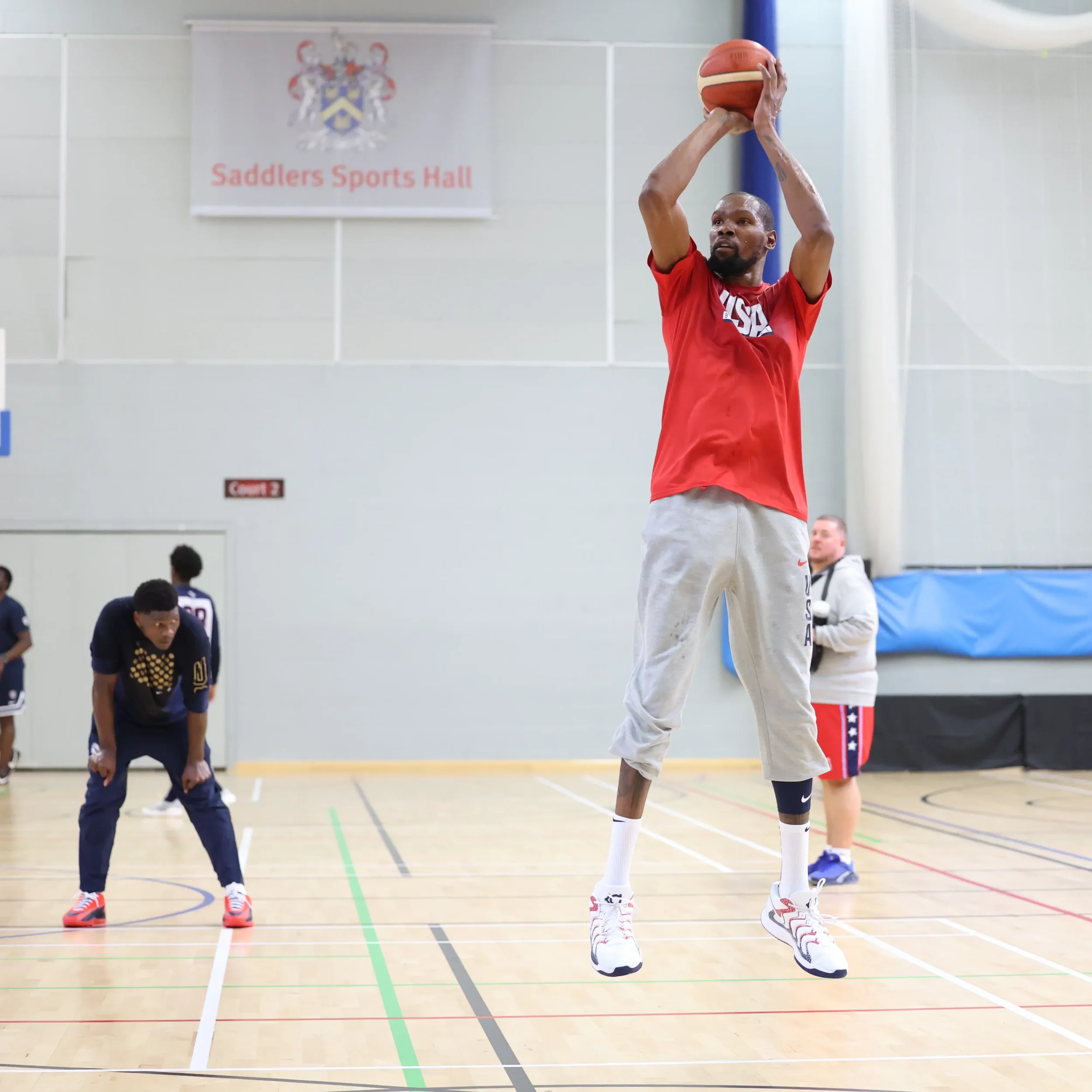
Kevin Durant shoots the ball while practicing.
Even the best players in the world emphasize intentional training over simply playing more games. Stephen Curry has often said it’s the hours in the gym when nobody is watching that make the difference. Kobe Bryant built his greatness on disciplined, repetitive skill work long before championships followed. Kevin Durant has said, “You don’t just play games to get better. You work on your craft every day.” At every level of basketball, development comes from focused reps — not just competition.
Not because it was chased — but because it was built.
